

Artificial Intelligence is evolving at a breakneck pace. While the past few years centered on Generative AI capabilities—like generating text, images, or code via prompts—the technological landscape is shifting toward a far more autonomous paradigm: Agentic AI.
For technology and product leaders, understanding what Agentic AI is is no longer just about tracking tech trends; it is the key to transforming operational efficiency and driving the next generation of intelligent digital products.
What Is Agentic AI?
Agentic AI refers to autonomous artificial intelligence systems designed to pursue and accomplish complex goals without requiring step-by-step human prompts or continuous supervision.
Unlike traditional AI or basic chatbots that operate strictly on a single prompt-and-response model, Agentic AI can:
Deconstruct high-level goals into actionable sub-tasks (planning & reasoning).
Integrate and use external tools (APIs, databases, software systems).
Execute multi-step workflows independently.
Evaluate and refine its own outputs (self-reflection and error-correction).
Definition Box (AI Snippet Ready):
Agentic AI is an autonomous AI system capable of planning, making decisions, leveraging external tools, and executing complex, multi-step workflows independently to achieve specified business objectives.
Generative AI vs. Agentic AI: Key Differences
A common point of confusion for leaders is the distinction between Generative AI vs. Agentic AI. While both leverage Large Language Models (LLMs) at their core, their operational scope and business impact differ significantly.
Feature / Characteristic | Generative AI | Agentic AI |
Interaction Model | Passive (Responds to single prompts) | Proactive & Autonomous (Iterative self-execution) |
Primary Focus | Creating content (text, images, code) | Completing end-to-end workflows & business tasks |
Workflow Capability | Single-turn responses | Multi-step planning and orchestration |
Tool Integration | Limited to chat interface context | Directly connected to APIs, databases, & SaaS tools |
Autonomy Level | Low (Requires human prompt for each step) | High (Operates independently within defined guardrails) |
Use Case Example | Writing an email draft or summarizing text | Managing end-to-end marketing campaigns or automated claims processing |
How Agentic AI Works in Enterprise Systems
To understand Agentic AI for enterprise applications, it helps to look at the core architectural components that drive an agentic workflow:
[ Objective / Goal ] ──> [ Reasoning & Planning ] ──> [ Tool Integration / APIs ] ──> [ Execution & Reflection ]
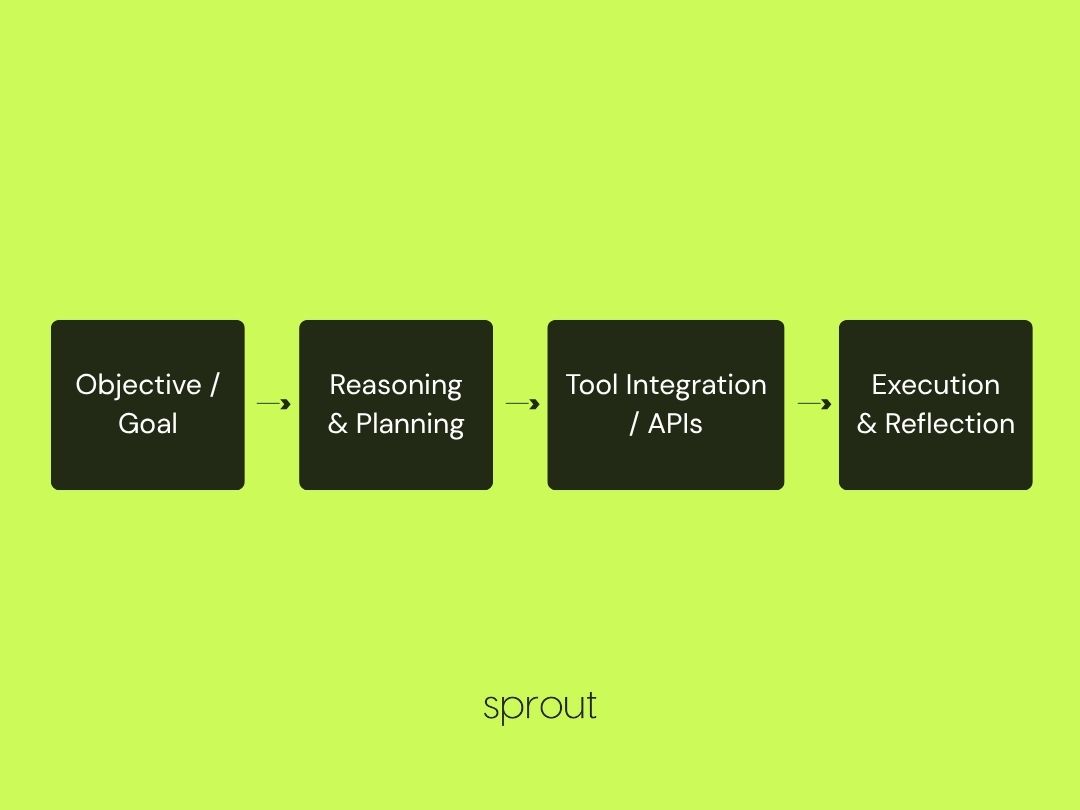
Reasoning & Planning: The agent receives a high-level goal (e.g., "Analyze Q3 churn rates and generate a risk report"), then breaks it down into logical steps.
Tool Integration: The agent calls external APIs, queries SQL databases, runs code, or interacts with enterprise software like CRMs and ERPs.
Memory Management: It maintains short-term memory (context of the current task execution) and long-term memory (enterprise knowledge bases via RAG).
Self-Correction & Reflection: If a step fails or produces an error, the Agentic AI analyzes the failure and attempts an alternative approach autonomously before delivering the final outcome.
Key Examples of Agentic AI in Business
Real-world Agentic AI examples span across various critical operational domains:
1. Advanced Customer Experience & Support
Going far beyond rule-based chatbots, agentic support agents verify user credentials, check backend databases, execute troubleshooting steps, and issue refunds automatically while complying with company policies.
2. Operations & Claims Automation
In insurance and banking, agents ingest claims documents, verify legitimacy using Intelligent Document Processing (IDP), evaluate compliance against policy guidelines, and approve valid claims within seconds.
3. Automated Software Engineering
AI agents can receive a feature specification, write the necessary code, run automated unit tests, identify bugs, fix issues autonomously, and submit a complete pull request in Git repositories.
4. Supply Chain & Inventory Optimization
Agentic systems continuously monitor inventory levels, predict demand based on market dynamics, and automatically issue Purchase Orders (POs) to suppliers when stock reaches defined thresholds.
Business Benefits of Agentic AI
Adopting Agentic AI across enterprise workflows yields measurable business outcomes:
Scalable Operational Efficiency: Automates labor-intensive, multi-step tasks, freeing domain experts to focus on strategic initiatives.
Faster Execution (Speed-to-Market): Reduces complex business workflows that once took days or weeks down to minutes.
Minimized Human Error: Guarantees consistent execution adhering strictly to corporate governance and compliance standards.
Cost Optimization: Maximizes resource allocation through intelligent, automated orchestration.
Building Agentic AI Solutions with Sprout
Deploying Agentic AI in an enterprise environment requires robust system architecture, security guardrails, and seamless integration with existing software infrastructure.
At Sprout, we partner with organizations to design, engineer, and deploy custom Agentic AI systems—from strategic AI roadmapping and LLM orchestration to building bespoke AI agents tailored to your industry.
Ready to transform your enterprise operations with autonomous AI workflows? Get in touch with the Sprout team to explore your implementation roadmap.
Frequently Asked Questions (FAQ)
What is the difference between an AI Agent and Agentic AI?
An AI Agent refers to a specific program or software entity designed to complete tasks. Agentic AI refers to the broader technological paradigm and architectural framework characterized by autonomous reasoning and tool execution.
Will Agentic AI replace human employees?
No. Agentic AI is built around a Human-in-the-Loop (HITL) architecture. The AI handles tedious, complex execution steps, while human teams retain control over high-level governance, ethics, and critical decision approvals.
How can my company start adopting Agentic AI?
Start by identifying repetitive, structured workflows that consume significant operational time. Partnering with an experienced AI and product engineering team like Sprout allows you to pilot high-impact Agentic AI workflows safely and effectively.